
- All
- Product Name
- Product Keyword
- Product Model
- Product Summary
- Product Description
- Multi Field Search
English

Views: 13 Author: Site Editor Publish Time: 2025-12-16 Origin: Site


A wide variety of laser systems are used in diverse applications such as materials processing, laser surgery, and remote sensing, but many of these systems share common key parameters. Establishing standardized terminology for these parameters prevents misrepresentation, and understanding these terms allows for the correct specification of laser systems and components to meet your application needs (as shown in Figure 1).
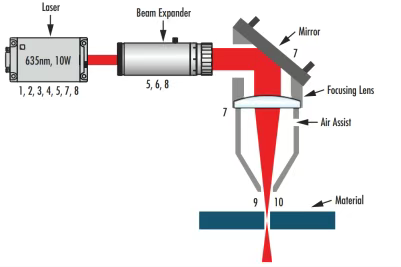
Figure 1: Schematic diagram of a typical laser material processing system, where the 10 key parameters of the laser system are indicated by corresponding numbers.
Basic Parameters
The following basic parameters are the most fundamental concepts of laser systems and are crucial for understanding more advanced topics.

The wavelength of a laser describes the spatial frequency of the emitted light wave. The optimal wavelength for a particular use case depends largely on the application. In material processing, different materials have unique wavelength absorption characteristics, leading to different interactions with the material. Similarly, atmospheric absorption and interference affect certain wavelengths differently in remote sensing, and in medical laser applications, different skin tones absorb certain wavelengths differently. Due to their smaller focused spot size, shorter-wavelength lasers and laser optics have advantages in creating small, precise features with minimal peripheral heating. However, they are typically more expensive and more susceptible to damage compared to longer-wavelength lasers.

Laser power is measured in watts (W), which is used to describe the optical power output of continuous-wave (CW) laser source or the average power of pulsed laser source. Furthermore, pulsed laser sources are characterized by their pulse energy, which is directly proportional to the average power and inversely proportional to the pulse repetition rate (Figure 2). Energy is measured in joules (J).
Pulse energy = Average power / Repetition rate/Pulse Energy/ = Average power / Repetition rate
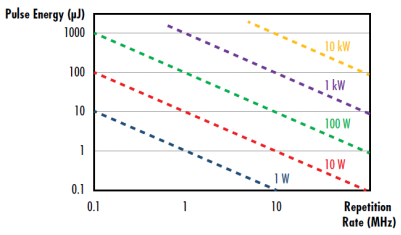
Figure 2: A visual representation of the relationship between pulse energy, repetition rate, and average power of a pulsed laser.
Laser source with higher power and energy are generally more expensive and generate more waste heat. Maintaining high beam quality also becomes increasingly difficult as power and energy increase.

The laser pulse duration, or pulse width, is typically defined as the time it takes for the laser to reach half of its maximum optical power (FWHM) (Figure 3). The characteristic of a ultrafast laser source is its short pulse duration, ranging from picoseconds (10⁻¹² seconds) to attoseconds (10⁻¹⁸ seconds).
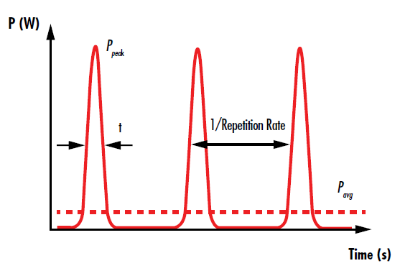
Figure 3: The pulse interval of a pulsed laser is the reciprocal of its repetition rate.

The repetition rate (or pulse repetition frequency) of a pulsed laser describes the number of pulses emitted per second, which is the reciprocal of the temporal pulse spacing (Figure 3). As mentioned earlier, the repetition rate is inversely proportional to the pulse energy and directly proportional to the average power. While the repetition rate typically depends on the laser gain medium, in many cases, it can be varied. A higher repetition rate results in shorter thermal relaxation times on the surface of the laser optical components and the final focused spot, thus leading to faster heating of the material.

Lasers possess coherence, meaning there is a fixed relationship between the phase values of the electric field at different times or locations. This is because lasers are produced through stimulated emission, unlike most other types of light sources. Coherence gradually decreases during propagation, and the coherence length of a laser defines the distance over which its temporal coherence maintains a certain quality.

Polarization defines the direction of the electric field of a light wave, which is always perpendicular to the direction of propagation. In most cases, lasers are linearly polarized, meaning the emitted electric field always points in the same direction. Unpolarized light produces electric fields pointing in many different directions. The degree of polarization is usually expressed as the ratio of the optical power of two orthogonal polarization states, such as 100:1 or 500:1.
Beam Parameters
The following parameters describe the shape and quality of the laser beam.

The laser beam diameter represents the lateral extent of the beam, or its physical size perpendicular to the direction of propagation. It is typically defined at the 1/e² width, which is the point where the beam intensity reaches 1/e² (≈ 13.5%) of its maximum value. At the 1/e² point, the electric field strength drops to 1/e (≈ 37%) of its maximum value. A larger beam diameter requires larger optical components and a larger overall system to avoid beam clipping, leading to increased costs. However, reducing the beam diameter increases the power/energy density, which can also have adverse effects (see the next parameter).

The beam diameter is related to the power/energy density of the laser beam (i.e., the optical power/energy per unit area). With constant beam power or energy, a larger beam diameter results in a lower power/energy density. High power/energy density lasers are usually the ideal final output for a system (e.g., in laser cutting or laser welding applications), but low power/energy density lasers are often beneficial within the system to prevent laser-induced damage. This also prevents the high power/energy density regions of the beam from ionizing the air. For these reasons, beam expanders are commonly used to increase the diameter and thus reduce the power/energy density within the laser system. However, care must be taken not to expand the beam too much, as this can cause the beam to be clipped by the system's apertures, leading to energy loss and potential damage.

The beam profile of a laser describes the intensity distribution across the beam's cross-section. Common beam profiles include Gaussian beams and top-hat beams, whose beam profiles follow Gaussian and top-hat functions, respectively (Figure 4). However, no laser can produce a perfect Gaussian beam or a perfect top-hat beam with a beam profile that perfectly matches the characteristic function, as there is always a certain amount of hotspots or oscillations within the laser. The difference between the actual laser beam profile and the ideal beam profile is usually described by several metrics, including the laser's M2 factor.
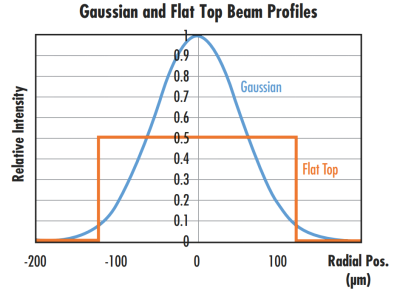
Figure 4: A comparison of the beam profiles of Gaussian and flat-top beams with the same average power or intensity shows that the peak intensity of the Gaussian beam is twice that of the flat-top beam.

Although laser beams are commonly considered collimated light, they always exhibit a certain degree of divergence. Divergence describes the extent to which the beam spreads relative to the beam waist after propagating over long distances due to diffraction. Divergence becomes a particularly important issue in applications with long working distances (e.g., lidar systems, where the target may be hundreds of meters away from the laser system). Beam divergence is typically defined by the half-angle of the laser, and the divergence (θ) of a Gaussian beam is defined as:
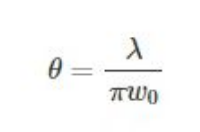
λ is the laser wavelength, and w0 is the laser beam waist.
Final System Parameters
These final parameters describe the performance of the laser system at its output.

The spot size of a focused laser beam describes the diameter of the beam at the focal point of the focusing lens system. In many applications, such as material processing and medical surgery, the goal is to minimize the spot size. This maximizes the power density and allows for the creation of particularly fine features (Figure 5). Aspheric lenses are often used instead of traditional spherical lenses to reduce spherical aberration and minimize the focal spot size. In some types of laser systems, the laser is not ultimately focused into a spot, in which case this parameter is not applicable.
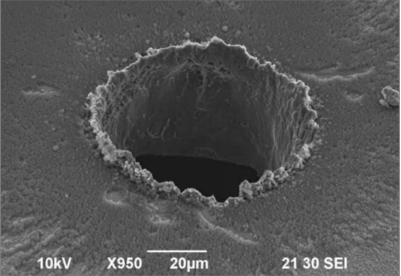
Figure 5: Laser micromachining experiments conducted at the Italian Institute of Technology show that, under constant fluence, the ablation efficiency of a nanosecond laser drilling system increases tenfold when the spot size is reduced from 220 micrometers to 9 micrometers.

The working distance of a laser system typically refers to the physical distance from the final optical element (usually the focusing lens) to the object or surface where the laser is focused. Some applications (such as medical lasers) usually aim to minimize the working distance, while other applications (such as remote sensing) typically aim to maximize the working distance range.